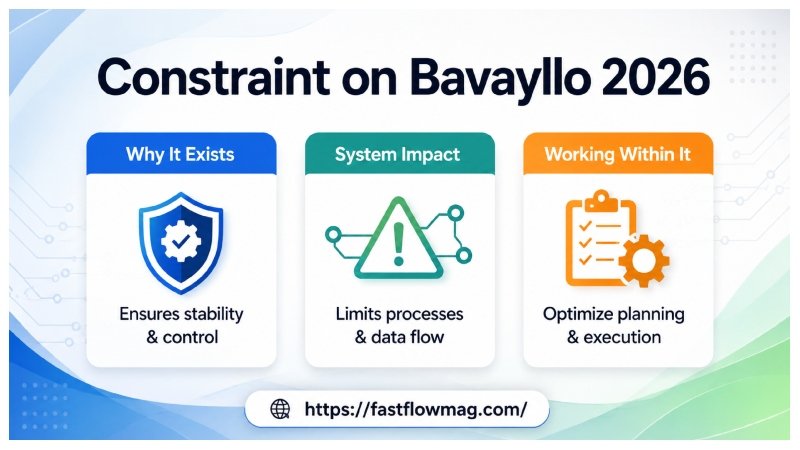
To begin with, modern digital systems are designed to improve speed, efficiency, and productivity. However, no platform works without limits. Every system eventually faces restrictions that influence performance, scalability, and user experience. This is where the idea of Constraint on Bavayllo becomes important.
Nowadays, many users search for this topic because they experience slow workflows, blocked actions, access issues, or technical bottlenecks while using modern platforms and structured systems. Therefore, understanding these limitations helps businesses, developers, and everyday users avoid common mistakes and improve performance.
Instead of viewing limitations as negative, smart organizations treat them as signals for improvement. In fact, constraints often reveal weak areas inside a workflow. Once those weak points are identified, systems become much easier to optimize.
This guide explains the concept in a simple and practical way. Additionally, you will learn the causes behind system restrictions, how they affect performance, and the best methods to reduce their impact.
Understanding System Constraints in Digital Platforms
The discussion around Constraint on Bavayllo often focuses on how operational limitations affect modern digital systems and workflows.
Every technology platform operates inside predefined boundaries. Generally, these boundaries may relate to speed, security, user access, infrastructure, or data handling.
In simple terms, a constraint is a factor that prevents a process from operating at full capacity. In many systems, one small bottleneck can reduce the performance of the entire workflow.
For example:
- A slow server can delay user requests
- Limited permissions can block important actions
- Incorrect data formats can trigger system errors
- Weak infrastructure can reduce reliability
Overall, such limitations are extremely common in modern software environments.
Why Constraints Exist
Many restrictions are intentionally designed into systems. As a result, they help protect platforms from misuse, overload, and security threats.
Without proper operational limits, systems could eventually become unstable. Therefore, constraints often improve reliability rather than damage it.
For example, some platforms use restrictions to:
- Protect user data
- Prevent server overload
- Reduce spam or abuse
- Maintain stable performance
- Improve security standards
Although users may sometimes feel frustrated by these limits, they often exist for practical reasons.
Major Causes Behind Performance Limitations
To understand Constraint on Bavayllo properly, it is important to examine the major causes behind system and workflow limitations.
In many cases, different factors can create workflow bottlenecks. Some are technical, while others relate to planning or resource management.
Infrastructure Problems
First of all, infrastructure plays a major role in overall performance.
Whenever servers lack capacity or network systems become overloaded, platforms begin slowing down. Users may notice delayed responses, failed requests, or interrupted workflows.
For example, common infrastructure issues include:
| Infrastructure Issue | Possible Impact |
|---|---|
| Slow servers | Delayed loading speed |
| Weak network connection | Connection failures |
| Outdated hardware | Reduced efficiency |
| Limited storage | Data processing issues |
| High traffic spikes | Temporary downtime |
Therefore, strong infrastructure is essential for smooth operations.
Configuration Errors
Secondly, incorrect settings are one of the most common causes of operational problems.
Many users skip setup instructions or apply incomplete configurations. As a result, systems begin rejecting tasks or limiting functionality.
For instance, simple configuration mistakes may include:
- Missing required values
- Invalid API settings
- Incorrect permissions
- Unsupported integrations
- Broken workflow rules
For this reason, reviewing settings regularly helps prevent unexpected failures.
Data Validation Issues
At the same time, modern platforms rely heavily on data accuracy.
When users upload unsupported formats or invalid information, systems may block requests automatically. This protects the platform from corruption or instability.
For instance, examples include:
- Oversized files
- Unsupported formats
- Duplicate entries
- Invalid characters
- Incomplete submissions
Consequently, data validation improves both security and operational consistency.
Access and Permission Restrictions
Furthermore, role-based systems control what users can access.
If someone lacks the required permissions, certain actions become restricted. This often happens in business software, team management tools, and enterprise systems.
As a result, permission restrictions may affect:
- Editing capabilities
- Administrative controls
- File access
- Integration management
- Reporting features
As a result, proper role management solves many workflow issues.
How Bottlenecks Affect Overall Performance
In many cases, one weak area can slow an entire system.
For example, imagine a highway with multiple lanes that suddenly narrows into a single lane. Traffic begins building immediately. The same principle applies to technology platforms.
Consequently, when one section struggles, the rest of the workflow becomes inefficient.
Common Effects of System Bottlenecks
Consequently, users may experience:
- Slower processing times
- Reduced productivity
- Delayed communication
- Increased operational costs
- Poor user experience
- Lower customer satisfaction
Eventually, these issues can affect business growth and long-term reliability.
Why Businesses Should Pay Attention to Operational Limits
Unfortunately, organizations that ignore workflow restrictions often face larger problems later.
For this reason, a small limitation today can become a major operational issue tomorrow.
As a result, businesses that actively monitor system performance gain several advantages:
- Better efficiency
- Faster decision-making
- Improved customer experience
- Lower technical risks
- Higher scalability
Moreover, companies that identify bottlenecks early usually spend less money fixing problems.
Practical Ways to Improve System Efficiency
Fortunately, businesses can reduce the impact of Constraint on Bavayllo through smart optimization and better infrastructure planning.
Overall, reducing workflow limitations requires planning, testing, and regular monitoring.
Monitor Performance Consistently
Most importantly, performance tracking helps teams detect issues before they become serious.
In particular, useful monitoring areas include:
- Server response times
- Workflow speed
- Error frequency
- Resource usage
- Database performance
Furthermore, regular reviews provide valuable insights.
Optimize Data Handling
Similarly, large amounts of unnecessary data reduce efficiency.
To improve efficiency, organizations should:
- Remove outdated records
- Compress large files
- Reduce duplicate information
- Improve database organization
- Validate submissions automatically
Therefore, efficient data management improves overall system speed.
Upgrade Infrastructure When Needed
However, many businesses delay infrastructure improvements until systems begin failing.
However, proactive upgrades reduce downtime and improve reliability.
In particular, important upgrades may include:
- Faster servers
- Cloud-based solutions
- Better storage systems
- Improved security tools
- Enhanced networking equipment
In the long run, modern infrastructure supports future growth.
Simplify Workflows
On the other hand, complex workflows often create unnecessary delays.
In addition, teams should remove repetitive steps and automate routine processes whenever possible.
As a result, automation helps:
- Reduce human error
- Increase productivity
- Improve consistency
- Save operational time
Therefore, simple systems are easier to manage and scale.
The Role of Security in System Restrictions
Without a doubt, security measures are one of the biggest reasons platforms introduce operational limits.
For this reason, without protective rules, systems become vulnerable to:
- Unauthorized access
- Data theft
- Malware attacks
- Spam activity
- Server abuse
Although some restrictions may feel inconvenient, they often protect users and organizations in the long run.
Common Security-Based Restrictions
For example, platforms frequently apply:
- Login attempt limits
- Access verification
- File upload restrictions
- Session timeouts
- Activity monitoring
Because of these protections, platforms improve both stability and user trust.
How Scalability Challenges Create Long-Term Issues
As platforms grow, managing performance becomes more difficult over time.
Likewise, systems designed for small workloads may struggle under heavy traffic. Without proper scalability planning, growth can create operational instability.
Signs of Poor Scalability
Because of this, businesses should watch for:
- Frequent crashes
- Slow page loading
- Increased downtime
- Database overload
- Delayed processing
Therefore, scalable systems are designed to handle growth efficiently.
Smart Scalability Strategies
To solve these issues, organizations can improve scalability through:
- Cloud infrastructure
- Load balancing
- Distributed databases
- Efficient caching
- Automated monitoring
As a result, these methods help maintain stable performance during periods of rapid growth.
Comparing Different Types of Operational Constraints
Importantly, not all limitations are the same. Some are temporary, while others require major structural changes.
| Constraint Type | Main Cause | Possible Solution |
| Technical | Hardware or software issues | Upgrade systems |
| Resource-Based | Limited staff or budget | Better allocation |
| Security-Based | Protection measures | Role optimization |
| Data-Related | Invalid inputs | Better validation |
| Process-Based | Complex workflows | Simplification |
Ultimately, understanding the category helps teams apply the correct solution.
Mistakes That Make System Problems Worse
Unfortunately, some organizations accidentally increase limitations through poor management.
Ignoring Early Warning Signs
In many situations, minor delays often signal deeper issues.
As a consequence, businesses that ignore small performance problems usually face larger failures later.
Overcomplicating Systems
Moreover, adding unnecessary tools, plugins, or integrations can reduce efficiency.
Therefore, simple workflows are often more stable than overly complex systems.
Delaying Maintenance
In addition, regular maintenance prevents many technical issues.
Similarly, failing to update software or monitor infrastructure can increase security risks and reduce performance.
Future Trends in System Optimization
As technology evolves, experts believe Constraint on Bavayllo will become easier to manage through automation and AI-powered systems.
Meanwhile, technology continues evolving rapidly.
Today, modern platforms increasingly rely on:
- Artificial intelligence
- Predictive analytics
- Automated optimization
- Smart monitoring systems
- Cloud-native infrastructure
As technology improves, these solutions help organizations detect bottlenecks faster and improve efficiency automatically.
Additionally, AI-powered monitoring tools can now predict failures before they happen. This allows businesses to fix problems early instead of reacting after downtime occurs.
Looking ahead, automation will continue shaping the future of operational management.
Benefits of Understanding Platform Limitations
Overall, organizations that understand operational boundaries make better strategic decisions.
For example, key benefits include:
- Improved workflow efficiency
- Better resource planning
- Faster problem-solving
- Reduced downtime
- Higher customer satisfaction
- More reliable scalability
In contrast, successful teams use restrictions as opportunities to improve performance instead of treating them as obstacles.
Conclusion
Overall, Constraint on Bavayllo highlights the importance of identifying operational bottlenecks before they damage system performance.
In reality, Constraint on Bavayllo is more than a technical phrase. It represents the operational limits that influence how systems perform in real-world environments.
Furthermore, every platform faces restrictions related to infrastructure, security, permissions, scalability, or workflow design. Understanding these limitations helps organizations reduce bottlenecks, improve efficiency, and create more reliable systems.
In other words, businesses that monitor performance, simplify workflows, and invest in strong infrastructure are better prepared for long-term success.
Rather than ignoring system limits, smart teams analyze them carefully and use them to guide better strategic decisions.
Finally, as technology continues evolving, organizations that adapt quickly will remain more efficient, scalable, and competitive.
Visit Fastflowmag.com